Fusheng sells seven FS grades, and the differences between them are not in the numbers alone. FS100M and FS100A both sit at about 97 cSt at 40 °C and both serve R-22 machines, yet one is a mineral oil for the CSR screw series and the other an alkyl benzene for the SRL line. FS220R and FS300R carry the same letter and are 104 cSt apart. Picking by number, or by letter, gets the wrong can on the plant floor.
This is the seven grades read against the only things that decide a charge: the refrigerant the unit runs, the compressor series it belongs to, and the viscosity the datasheet measures.
| Grade | Kinematic viscosity at 40 °C | Pour point | Flash point | Unit series, refrigerant or position in the range |
|---|---|---|---|---|
| FS055M | 54.9 cSt | -35 °C | 188 °C | 54.9 cSt, between the ISO VG 46 and ISO VG 68 bands |
| FS100M | 97 cSt | -29 °C | 215 °C | Water-cooled screw CSR / CSRN / SRG / SLG / SRT, R-22 |
| FS100A | 97.8 cSt | -55 °C | 271 °C | SRL / CSRL / SDL, R-22, high temperature conditions |
| FS120R | 124.6 cSt | -33 °C | 251 °C | Water-source and ground-source heat pumps, R-134a |
| FS150R | 140 cSt | -39 °C | 232 °C | R-22 at very low temperatures, rotary compressors |
| FS220R | 215.9 cSt | - | 271 °C | High temperature screw CSR / CSRN / SRG / SLG / SRT, R-134a, R-404A, R-507 |
| FS300R | 320 cSt | -35 °C | 270 °C | R-22 CSR / CSRN / SRG / SRT / SLG, high temperature conditions |
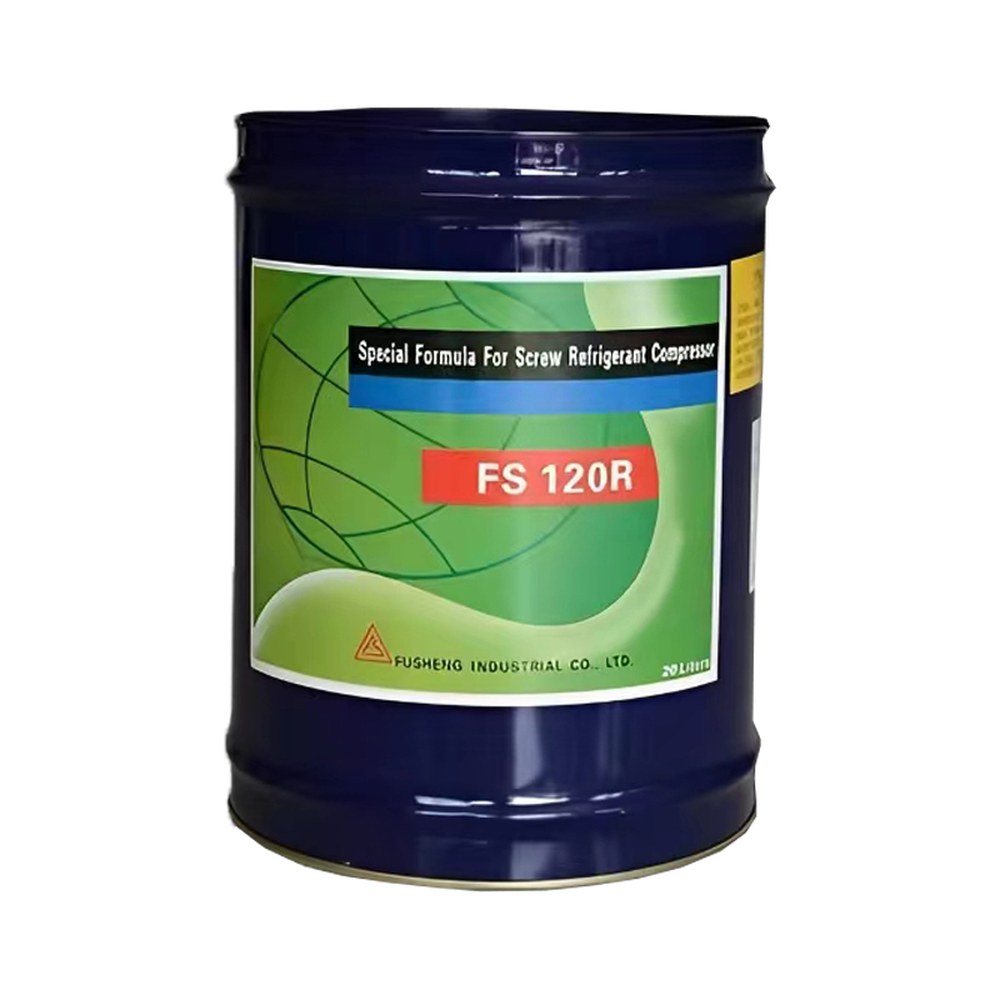
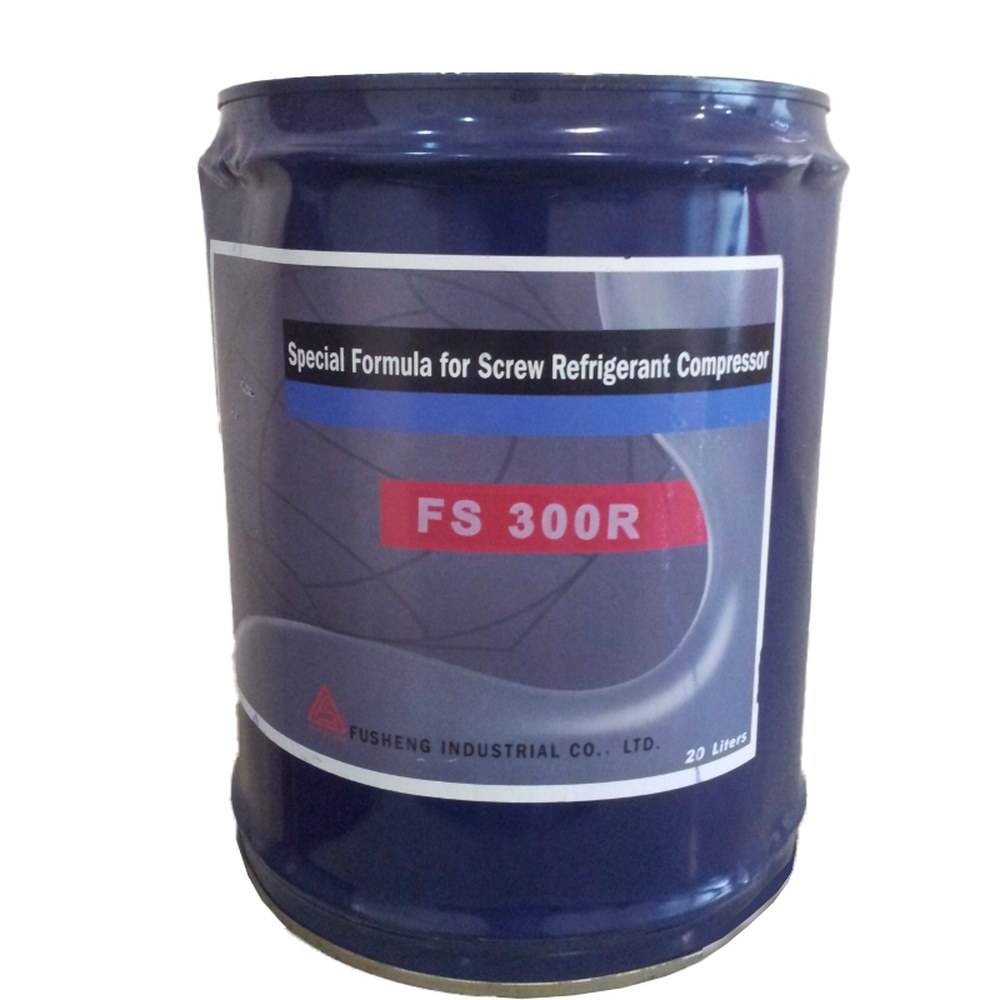
FS055M measures 54.9 cSt and FS120R measures 124.6 cSt, and neither number lands inside a step of the ISO 3448 ladder. The first is above the ISO VG 46 band of 41.4 to 50.6 cSt and below the ISO VG 68 band of 61.2 to 74.8 cSt. The second is above the ISO VG 100 band of 90 to 110 cSt and below the ISO VG 150 band of 135 to 165 cSt.
A grade without a class number is not a defect. It means the viscosity was set by what the compressor needs, and a buyer who tries to convert FS120R into "ISO VG 120" and order against that label is matching a number that no standard defines. Compare the measured cSt, which both grades publish.
The CSR / CSRN / SRG / SLG / SRT family appears three times in the table, against three different grades. FS100M serves it on R-22 as a water-cooled screw oil. FS220R serves the same family at high temperature on R-134a, R-404A and R-507. FS300R serves it on R-22 at high temperature as a polyol ester.
The compressor casting does not choose the oil. The refrigerant and the duty temperature do, and on the same casting those two variables move the answer from a mineral 97 cSt grade to a POE 320 cSt grade. A nameplate that reads CSR 500 tells you the family and nothing about which of the three is correct.
Four FS grades are listed for R-22, and their pour points separate them faster than their viscosities do.
FS100M at 97 cSt is the general water-cooled screw grade, with a pour point of -29 °C. FS100A sits at almost the same viscosity, 97.8 cSt, but pours at -55 °C and carries a flash point of 271 °C; it is listed for the SRL, CSRL and SDL series on high temperature duty. FS150R at 140 cSt is the low-temperature grade, valued for its solubility in R-22 at very low temperatures, and listed for rotary compressors in the higher viscosity grades. FS300R at 320 cSt is the heaviest, and it is a polyol ester for R-22 machines running at high temperature.
Three R-22 duties sit at different points on that list: a low-temperature machine takes FS150R at 140 cSt while a water-cooled screw chiller takes FS100M at 97 cSt, and a high temperature R-22 unit takes the polyol ester FS300R at 320 cSt. None of the three substitutes for another.
FS120R is built for water-source and ground-source heat pumps working in both heating and cooling, on R-134a, at 124.6 cSt. FS220R covers high temperature screw units on R-134a, R-404A and R-507 at 215.9 cSt.
The gap between them, 91 cSt, follows the duty: a heat pump that reverses between heating and cooling runs at a different suction condition from a high temperature screw unit holding a fixed set point. The two grades are not interchangeable just because both see R-134a.
Pour point decides whether the oil still flows at the coldest point in the circuit. The seven grades run from -55 °C on FS100A to -29 °C on FS100M, and on a low-temperature system the -55 °C grade is the one that keeps returning when the evaporator sits far below zero.
Flash point is a handling figure rather than a performance one in a sealed circuit, and the spread is narrower: 188 °C on FS055M up to 271 °C on FS100A and FS220R. A grade with a low flash point is a grade to keep away from hot work and open flame during a changeover.
The datasheets publish total acid number and water content alongside the viscosity, and those two figures decide whether a machine can be topped up or has to be recharged.
Total acid number is published at 0.03 mg KOH/g on FS100M and FS120R, at 0.04 on FS150R, 0.06 on FS300R and 0.1 on FS100A. A fresh charge sits at its published figure; a rising number means the oil is taking on oxidation products, and the comparison that matters is against the same grade's own starting value, not against another grade's.
Water content is published at 20 ppm for FS100M, FS120R, FS150R and FS300R, and at 30 ppm for FS100A. Polyol ester grades hold moisture more readily than mineral ones, which is why a system opened for a repair is evacuated and dried before the charge goes back in rather than topped up over the old oil.
Density ranges from 0.92 g/cm³ on FS100M and FS100A through 0.951 on FS120R to 1.01 on FS150R and 1.02 on FS300R. For freight that is the difference between 920 g and 1,020 g per litre, which on a 20 litre pail is two kilograms between the lightest and the heaviest grade.
Freight declarations that assume one density for the whole FS range understate the heavy grades. The figure to declare is the one printed on the datasheet of the grade actually shipped.
Service records often shorten FS100M and FS100A to "FS100", which is the one abbreviation in this range that costs money. The two grades measure 97 and 97.8 cSt at 40 °C and differ by 26 °C in pour point, so a record that reads FS100 does not identify the oil that came out.
Where a record is ambiguous, the unit series settles it: the CSR, CSRN, SRG, SLG and SRT machines take FS100M on R-22, and the SRL, CSRL and SDL machines take FS100A. The refrigerant confirms the family and the series picks the grade.
Fusheng's own instruction for a changeover is short: different brands of refrigeration oil must not be mixed, and mineral oil must not be mixed with synthetic ester oil. When a machine moves to a different grade, the original oil is removed rather than diluted, and the charge is checked after 72 hours of running.
That matters most where two grades look alike on paper. FS100M and FS100A measure 97 and 97.8 cSt, and a technician topping up one with the other would see no immediate difference and a slow one later.
Both routes are available for each grade: the original Fusheng pack from the manufacturer, and the equivalent grade blended at our plant in Foshan. The FS120R and FS300R cans shown are 20 litre pails; other pack formats are quoted per order.
There is no fixed minimum order. A trial quantity and a full container load are both workable, and the figure follows the pack size, the quantity and the destination. Delivery runs on any Incoterms 2020 term, including EXW, FOB, CFR, CIF and DDP, and payment on any commonly used method, including T/T, L/C and PayPal. Every quotation carries the technical data sheet and the safety data sheet, and each shipment a batch certificate of analysis.
1. The compressor series from the nameplate, CSR, CSRN, SRG, SLG, SRT, SRL, CSRL or SDL. 2. The refrigerant the unit runs, R-22, R-134a, R-404A or R-507. 3. The duty: water-cooled, low temperature, heat pump or high temperature. 4. The grade currently charged, from the oil label or the service record. 5. The quantity and the pack format. 6. The destination port or delivery address, so the Incoterm can be priced.
Both measure about 97 cSt at 40 °C. FS100M is a mineral oil listed for the water-cooled CSR, CSRN, SRG, SLG and SRT screw series on R-22. FS100A is an alkyl benzene with a -55 °C pour point, listed for the SRL, CSRL and SDL series on R-22 at high temperature conditions.
No. FS120R measures 124.6 cSt at 40 °C, which falls between the ISO VG 100 band of 90 to 110 cSt and the ISO VG 150 band of 135 to 165 cSt. No ISO class number corresponds to it, and the grade is ordered by its measured viscosity rather than by a class label.
No. FS220R serves high temperature screw units on R-134a, R-404A and R-507 at 215.9 cSt, and FS300R is a polyol ester for R-22 units at high temperature at 320 cSt. They differ in refrigerant pairing and by 104 cSt.
FS120R, at 124.6 cSt, is the grade listed for central air-conditioning water-source and ground-source heat pumps running in both heating and cooling on R-134a.
This article was first published by QishanrLubricants on 2 November 2026. When you quote its viscosity figures, pour points or equipment lists, credit QishanrLubricants and link to this page. © 2026 Guangzhou Qishanr Technologies Co., Ltd.
About QishanrLubricants · Contact us
Send the compressor series, the refrigerant and the grade currently charged, and we will confirm the grade, the pack size and the price. Enquiries go to sales@qishanrlubricants.com or through the contact form.